Can You Really Just “Build” Restaurant AI In-House? Here’s What Operators Need to Know Before They Try
Mar 26
Human-led AI in restaurant operations means pairing artificial intelligence tools with experienced operators who know how to configure, interpret, and act on what the data produces. The alternative, building a system in-house using general-purpose AI and internal staff, sounds appealing until you price out what it actually costs to get it right.
This is the build-vs.-buy question every multi-unit operator eventually asks. And more recently, the question sounds like this: “Can’t we just vibe-code something with AI and call it a day?”
The short answer is: you can try. Most operators who do eventually call us anyway, a few painful months later.
What “Building It In-House” Actually Looks Like
When your tech-forward team member says they can build a forecasting tool, here is what that process typically involves:
Data extraction. Pulling structured sales data from your existing technology platforms in a format that a model can actually read. This alone takes weeks if you have never done it.
Cleaning and normalizing the data. Your POS data is messier than you think. Voids, comps, 86’d items, daypart shifts, and location-level quirks all have to be accounted for.
Building a model. What algorithm? Trained on what? How far back? How does it handle a new location with no history?
Translating model outputs into prep sheets. A prediction is not a prep sheet. Someone has to map item-level forecasts to actual quantities, account for batch sizes, waste percentages, and cook times.
Testing and calibrating. Your first model will be wrong. Calibration takes real operational cycles, not sprint cycles.
Maintaining the model over time. Menu changes, seasonality shifts, new locations, price increases. Every change breaks something.
Training your managers to use it. A tool no one trusts or understands does not get used.
That is not a weekend project. That is a six-to-twelve month engagement for a team that has done it before, and longer for one that has not. And that’s just to build it, you still have to invest time to maintain it.
The Two Types of Human-AI Collaboration (And Why the Difference Matters)
Not all AI implementations are equal. A useful framework, cited by AI researchers and senior fellows at institutions like Harvard, breaks this down by risk and complexity.
The key distinction is not just “human plus AI.” It is who leads.
For restaurant forecasting, prep planning, and labor alignment, the task is complex. Deciding how much brisket to smoke overnight or how much chicken to thaw for a Tuesday lunch rush involves dozens of variables: weather, local events, recent sales trends, menu mix, manager experience, and more.
This is a human-led-plus-AI problem. Which means the human leading it needs to have done it before.
If your in-house tech person is leading, they are learning on your dime. If a vendor with hundreds of operational deployments is leading, you get the benefit of all of those reps from day one.
ClearCOGS Is Built Around This Distinction
ClearCOGS is an AI-powered restaurant forecasting and operations platform that combines data science with hands-on operational expertise. Our team includes data scientists optimizing models at the item level and operators who have run restaurants and know what a prep sheet has to look like at 6 AM to actually get used.
That combination is not accidental. It is the core of why our system works where in-house builds typically stall.
When a new customer onboards with ClearCOGS, they are not just plugging into software. They are working with people who have configured forecasting systems across hundreds of locations, across fast casual and QSR concepts, and who understand the gap between what a model predicts and what your team can execute.
Is ClearCOGS Right for Your Restaurant Group? Read more here.
What “Vibe Coding” a Forecasting Tool Actually Costs
Let’s make this concrete. Here is a realistic cost breakdown for an operator attempting to build in-house versus partnering with an expert platform.
In-House Build: What You Are Really Spending
Internal dev time: 6 – 12 months of a technically-skilled employee’s time, at full salary and benefits
Data infrastructure: POS data extraction, storage, and pipeline tooling
Model iteration: Multiple failed versions before something usable ships
Ongoing maintenance: Every menu change, location addition, or seasonal shift requires developer time
Opportunity cost: That person is not working on anything else for your business
Operators who have gone this route frequently report spending the equivalent of $80,000 to $150,000 in internal resources before they have something close to production-ready. And “close to production-ready” is not the same as accurate, trusted, and used by your managers every day.
Expert Partner: What You Get From Week One
Forecasting configured to your POS data, your menu, your locations
Prep sheets your managers can actually read and act on
Calibration cycles that improve accuracy over time
Ongoing model updates as your business changes
ROI measurable in weeks, not quarters
How AI-Powered Restaurant Forecasting Is Revolutionizing Multi-Unit Operations” Read more here.
The Real-World Difference: A Day in the Life
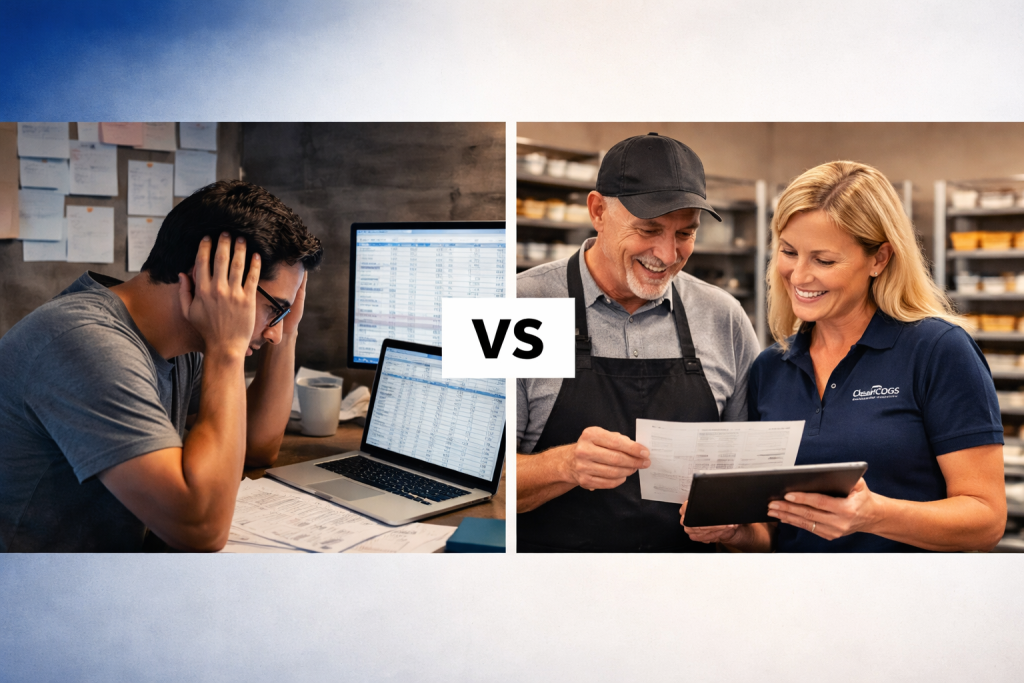
In-house build scenario: It is 6 AM. Your opening manager pulls up the spreadsheet your tech team built three months ago. The numbers look off because the model was not updated after you added the new protein bowl to the menu. She does what she always does: she ignores it and preps from gut feel. Thirty percent of that chicken goes in the trash by close.
Expert-managed AI scenario: It is 6 AM. Your opening manager opens her ClearCOGS prep sheet. It accounts for last Tuesday’s numbers, today’s weather, the upcoming lunch rush, and the fact that chicken bowl sales spike on Thursdays. She preps exactly what the sheet says. Food cost is on target.
The difference is not the technology. The difference is whether the system was configured by people who understand both the AI and the operation.
What Operators Actually Need to Make AI Work in Their Kitchens
If you are evaluating whether to build or buy, run through this checklist first.
Before committing to an in-house build, can you confirm:
You have someone with data science or ML experience on staff full-time
Your POS data is clean, structured, and exportable in a usable format
You have a process for maintaining the model when your menu changes
You have a plan for how managers will be trained on and held accountable to the tool
You have budgeted 6 to 12 months before expecting reliable outputs
You have a backup plan for when the model breaks (and it will)
If you checked fewer than four of those boxes, you are not ready to build in-house.
Why ClearCOGS Is Different From Other Software Builds
Most software your team can build is relatively static. A reporting dashboard. A scheduling template. A loyalty program integration.
Restaurant AI forecasting is none of those things. It is a living model that has to learn your business, adapt to change, and translate its predictions into something a busy line cook or a new manager can act on in under 60 seconds.
The operators who get the most from AI systems are the ones who treated the implementation like what it is: a complex, human-led process that requires experienced guidance, not a plug-and-play tool that runs itself.
From Go-Kart to Jet Engine: The Restaurant AI Playbook That Actually Works” Read More.
What the Research Actually Says About AI Implementation
AI researchers who study enterprise adoption consistently note that the biggest implementation failures happen when organizations treat AI as a solution to be deployed rather than a capability to be developed. The distinction is meaningful.
Deploying AI means handing it to your team and expecting results. Developing AI as a capability means investing in the human layer: the people who configure it, interpret it, and translate it into action on the floor.
For restaurant operators, that human layer is the product. Not the algorithm.
AI’s Real Restaurant Impact: From Data Chaos to Smart Decisions” Read More.
What Operators Who Tried to Build Have Said
Operators who attempted an in-house build before coming to ClearCOGS often describe the same arc: excitement at the start, a working prototype by month two or three, and then a slow realization that getting it to 60% accuracy is very different from getting it to the 85% to 90% accuracy that actually changes manager behavior.
The gap between “it kind of works” and “my team trusts it enough to follow it every day” is where in-house builds almost always break down. Because that gap is not a technology problem. It is an operational expertise problem.
Building restaurant AI in-house is technically possible, but operationally expensive and slow to produce reliable results. The most important factor in AI success is not the algorithm: it is the human expertise guiding the implementation. Human-led AI, where experienced operators configure and manage the system, consistently outperforms AI-led deployments in complex, high-variability environments like restaurants. The real cost of an in-house build includes developer time, calibration failures, manager trust gaps, and months of inaccurate prep decisions. Operators who partner with expert platforms start seeing measurable results in weeks, not quarters, because they get both the technology and the operational knowledge behind it.
Frequently Asked Questions
Can we use ChatGPT or another general AI tool to build our own forecasting system? General-purpose AI tools can help you write code and process data, but they do not come pre-trained on restaurant operations. Building an accurate, manager-ready forecasting system still requires significant configuration, data cleaning, and operational expertise. The tool is not the hard part. Knowing what to build and how to make it trusted on the floor is.
What if we already have a data analyst or tech person on staff? That is a great start. But restaurant forecasting requires someone who understands both data science and restaurant operations. A data analyst who has never set a prep list or managed a walk-in will build something technically functional that your managers will not use. The operational context is not a nice-to-have: it is the reason the output makes sense to the people who need to act on it.
How long does it take to build something reliable in-house? Most operators who attempt a full in-house build report 6 to 12 months before the system is reliable enough to influence daily decisions. Many never reach that threshold before deciding to switch to a managed platform.
What makes ClearCOGS different from just buying AI software? ClearCOGS is not just software. It is a managed service that includes the data science, the operational configuration, and the ongoing calibration. You are not buying a tool and figuring it out yourself. You are getting a team that has done this across hundreds of locations and knows how to make it work inside your specific operation.
Is there an ROI argument for building in-house? In the short term, an in-house build can seem like the cheaper option if you have technical staff on payroll. But when you account for the time to reach reliable accuracy, the ongoing maintenance burden, and the months of suboptimal prep decisions while you get there, the math typically favors an expert platform. Six months of internal development costs more than a year of a managed subscription, and you get results from week one instead of month nine.
Restaurant Technology Fear vs. Reality: Why Waiting Costs More Than Acting” Read More.
Ready to see what human-led AI looks like in your operation? Book a time with our team below.