




By Matt Wampler, CEO of ClearCOGS
Most operational reporting discussions in restaurants focus on what the data shows. Whether food cost is running high. Whether labor is in line. Whether this week’s sales are tracking to plan.
The conversation that rarely happens is about what the data gathering itself costs.
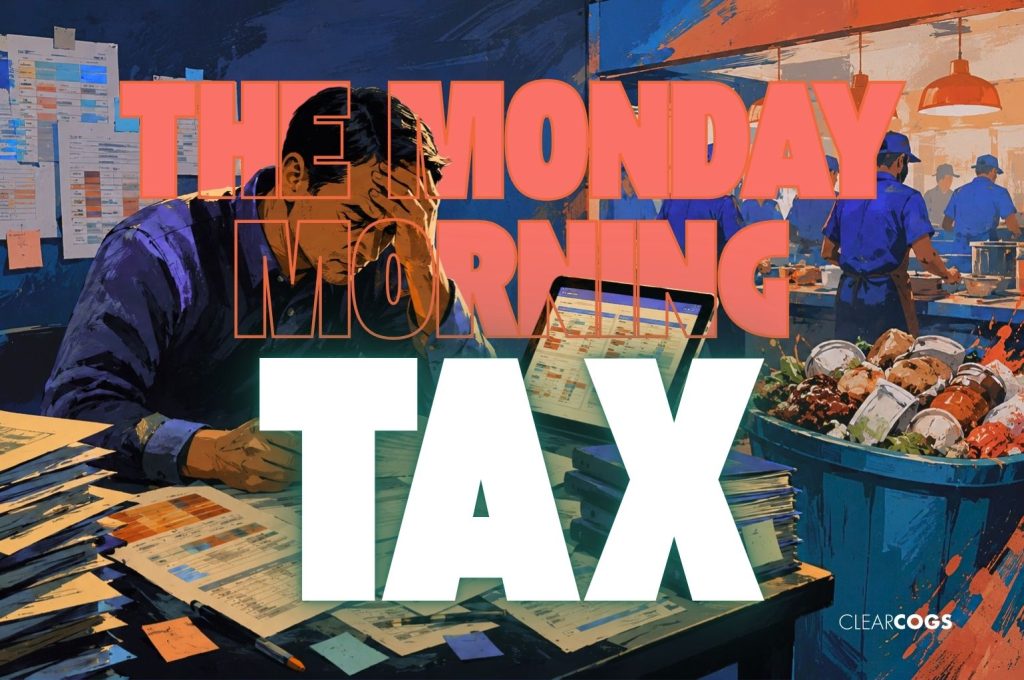
For a multi-concept operator running three brands across 14 locations, the Monday morning review is not a 10-minute read. It is a 45-minute exercise in manual data assembly: opening separate reports by location, logging into multiple systems, normalizing metrics across concepts that measure performance differently, and building a picture in your head that none of the individual tools was designed to produce. By the time the picture comes together, half the morning is gone and no operational decision has been made yet.
That overhead has a direct cost. It also has an indirect one that is harder to see and more damaging over time.
Putting a Number on the Ritual
The morning data assembly ritual is difficult to quantify precisely because it varies by operator, by system configuration, and by how many concepts are in the portfolio. But a conservative estimate is not hard to construct.
Assume 20 to 30 minutes per week per location for cross-system data gathering across a multi-concept portfolio. That includes morning reviews, mid-week performance checks, and any manual reconciliation needed to compare performance across brands.
Annual management hours consumed by data assembly
| Weekly time per location | 5 locations | 10 locations | 14 locations | 20 locations |
|---|---|---|---|---|
| 20 min/location/week | 87 hrs/year | 173 hrs/year | 243 hrs/year | 347 hrs/year |
| 30 min/location/week | 130 hrs/year | 260 hrs/year | 364 hrs/year | 520 hrs/year |
At a loaded senior operator cost of $36/hour (based on a $75,000/year salary assumption), the 14-location example at 30 minutes per location per week costs approximately $13,100 per year in direct management time. That is time spent assembling data rather than acting on it, with zero operational output until the assembly is complete.
The more consequential cost is what happens to decision quality in the meantime.
The Invisible Cost of Stale Data
Manual data assembly is not just slow. It is retrospective. The picture an operator assembles on Monday morning reflects last week’s performance. By the time the signals are visible, the decisions that could have been made with them have already happened.
A location that ran 8 percentage points over theoretical food cost in the third week of the month shows up as a data point in the Monday review. The prep decisions that generated that variance happened 7 to 10 days earlier. The intervention window is gone.
The gap between when data is generated and when it reaches a decision-maker is a structural feature of manual, fragmented reporting. It is not a technology failure. It is the predictable output of a process that was designed to report rather than to alert.
According to a February 2026 analysis from Back Office, referencing the National Restaurant Association’s 2025 State of the Industry data, 67% of operators have added more technology to their operations in recent years. Yet without integration across those tools, the data that exists inside each system stays siloed. POS data shows sales trends. Inventory data tracks purchases. Labor data records hours. The connection between all three, the view that answers “why are margins drifting at Location 9?”, requires someone to assemble it manually.
The Recipe Data Problem Makes It Worse
The visibility gap is particularly pronounced for operators who have grown through acquisition.
Concepts that were built by the current operator typically have clean recipe data: structured build-outs, gram-level specs, POS-linked menu items. Acquired concepts, especially smaller owner-operated businesses, may have no digitized recipe data at all. The prior owner’s production system was verbal or lived on a handwritten card.
This creates an asymmetric portfolio. Some brands can be analyzed accurately. Others cannot, because the theoretical food cost calculation that drives the analysis requires recipe data that does not exist in a usable format.
Recipe data status by concept origin
| Concept origin | Recipe data status | Theoretical cost visibility |
|---|---|---|
| Owner-built from scratch | Complete digital records | Full visibility possible |
| Acquired mid-size operation | Partial: menus digital, recipes incomplete | Partial: menu-level only |
| Acquired mom-and-pop | None: verbal or handwritten | No visibility until rebuilt |
Getting to parity across all concepts requires someone to sit down and reconstruct the missing recipe data from scratch. That project competes with every other operational priority and almost never wins. The visibility asymmetry persists, and the concepts where the operator has least data tend to remain the ones with the least scrutiny.
What Integrated Visibility Actually Returns
The case for integrated cross-concept visibility is not primarily about saving 30 minutes every Monday morning, though that compounds meaningfully at scale. The more important return is changing what the operator can do with the data that already exists.
When cross-location and cross-concept data is normalized and available without manual assembly, the question changes from “how did we do last week?” to “which locations are deviating from expected patterns right now, and why?” That is a different kind of analysis, and it is the kind that drives intervention rather than retrospective review.
A location that is running consistently above theoretical food cost across multiple weeks is visible as a pattern when data is integrated. The same location inside a manual reporting structure surfaces as a number on a spreadsheet that someone has to interpret against other numbers from other spreadsheets, on a delay.
The morning should start with decisions. The data assembly should happen before the operator arrives.
Sources
- Back Office. Restaurant Technology Stack and Integration Analysis. February 2026. bepbackoffice.com
- National Restaurant Association. 2025 State of the Restaurant Industry. 2025. restaurant.org
- Bureau of Labor Statistics. Food Service Managers: Occupational Outlook Handbook. May 2024. bls.gov
- FSR Magazine. Restaurants Reach a Technology Turning Point Rooted in Simplicity. 2025. fsrmagazine.com


