

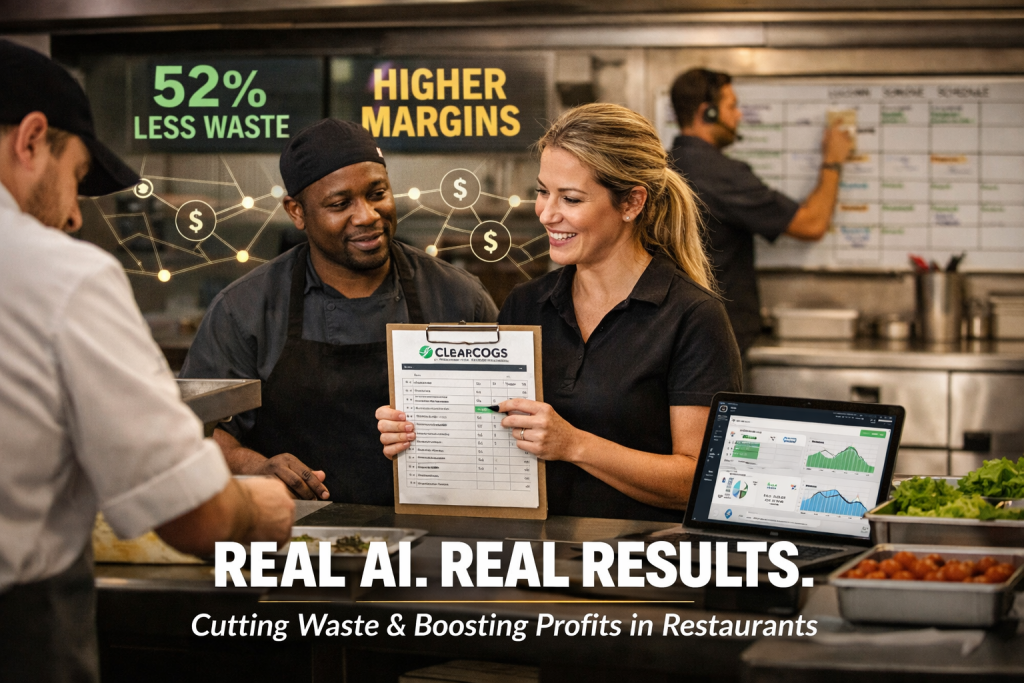



Real AI doesn’t live in a sales deck. It lives in your prep sheet, your labor schedule, and your bottom line.
Restaurant operators are right to be skeptical. A recent piece in QSR Magazine made a sobering point: an MIT report from August 2025 found that 95 percent of generative AI pilots at major companies were failing. The article warned that countless vendors are guilty of “AI-washing,” slapping the words “AI-powered” on legacy products that haven’t materially changed in years. When you’re running on razor-thin margins, that kind of misdirection isn’t just annoying. It’s expensive.
But here’s what the skeptics get wrong: the problem isn’t AI. The problem is fake AI. And there’s a big difference.
What Real Restaurant AI Actually Means
Real AI for restaurants is the application of machine learning and neural networks to predict operational decisions such as how much to prep, how many people to schedule, and which menu items to push. It delivers accuracy that consistently outperforms human guessing.
It is not a chatbot on a webpage. It is not a four-week sales average with a fancy dashboard. It is not a third-party ChatGPT plug-in repackaged as a “proprietary system.”
Real AI ingests your historical sales data, layered with variables like weather, local events, seasonal shifts, and day-of-week patterns, and produces actionable guidance your managers can act on before the first ticket prints.
ClearCOGS Is Built Differently
ClearCOGS is an AI-powered restaurant intelligence platform purpose-built for multi-unit operators. It delivers daily prep forecasts down to the ingredient level, labor scheduling predictions, and menu item demand forecasting, all trained on your restaurant’s specific data, not generic industry benchmarks.
ClearCOGS doesn’t ask your managers to become data analysts. It turns complex pattern recognition into a simple, usable output: a prep sheet that tells your team exactly what to make this morning and a labor forecast that shows who to schedule next week. The goal is to keep managers off spreadsheets and on the floor where they actually create value.
The “AI-Washing” Problem Is Real: Here’s How to Spot It
The QSR Magazine article put it plainly: companies that have offered the same legacy product for years are suddenly labeling everything “AI-enabled.” Operators are falling for it, and it’s costing them capital and time they don’t have.
Watch for these red flags when evaluating any AI vendor:
- They can’t explain, in plain language, what data their model is trained on
- Their “AI” produces the same recommendation regardless of your specific location or recent sales trends
- Accuracy claims exist in the sales deck but not in a live demo or pilot
- There’s no measurable baseline, they can’t tell you what success looks like in numbers
- Implementation takes months and requires a dedicated internal champion to keep it alive
- When you ask for a reference customer, they stall
The four questions to ask every AI vendor before signing anything:
- What manual processes will my managers no longer have to do after going live?
- What forecast accuracy should I expect, and how do I verify it independently?
- What happens to adoption when my internal champion leaves?
- Can I see the accuracy performance report from a current customer in my segment?
If a vendor hedges on any of these, keep walking.
What AI-Powered Forecasting Actually Looks Like in Practice
Here’s what the real version looks like on a Tuesday morning.
Your opening manager walks in at 6 AM. Instead of pulling up last week’s sales on a spreadsheet, guessing what Tuesday usually looks like, and adding a mental buffer “just in case,” she opens her ClearCOGS prep sheet. It already accounts for the fact that it’s a cold, rainy day (historically a 12% dip in foot traffic at her location), that there’s a school holiday driving earlier family traffic, and that the smash burger has been trending up for three weeks. The sheet tells her exactly how many pounds of beef to pull, how many buns to thaw, and how much of each sauce to prep.
She’s done with back-office decisions in under five minutes. She’s on the floor by 6:15.
That’s what real AI looks like. Not a dashboard of KPIs. Actionable guidance, before the day starts.
The Science Behind It (Without the Jargon)
The ClearCOGS approach is grounded in how neural networks actually learn. Think of it like Google’s autocomplete feature. Early versions simply showed the most commonly typed words, accurate about 12% of the time. Once Google applied machine learning that analyzed your specific search history, location, and behavior patterns, accuracy jumped above 90%.
The same principle applies to your restaurant. A simple moving average of past sales is the equivalent of old-school autocomplete. ClearCOGS’s model analyzes the unique patterns of your specific locations, such as how your Tuesday lunch behaves differently after a holiday weekend, how a 90-degree day changes your drink-to-entree ratio, and how a limited-time offer shifts demand across your whole menu. That’s the difference between a guess dressed up in a bar chart and a real forecast.
Read the full breakdown of how AI actually works in restaurants →
Real Operators. Real Numbers. No Mirage.
Palenque Group: Hours Back, Food Costs Down
Palenque Group’s managers were spending significant time each week manually calculating prep quantities across their locations. Guesswork drove inconsistency and food cost overruns. After implementing ClearCOGS, prep guesswork was eliminated, managers recovered hours previously lost to back-office calculation, and food costs dropped measurably. The system paid for itself quickly, not because it was impressive technology, but because it solved a real daily problem.
Read the Palenque Group case study →
Three BBQ Brands: 55% Waste Reduction, Zero System Changes
Three separate barbecue restaurant brands, including Red, White & Que and Dinosaur Bar-B-Que, cut prep waste by 55% using ClearCOGS. Critically, they didn’t change their POS, their ordering system, or their back-of-house setup. ClearCOGS layered on top of what they already had and immediately improved the decisions their teams were making every day.
One pitmaster at Red, White & Que had been prepping seven racks of ribs per shift as his standard. ClearCOGS recommended thirteen. He was skeptical, nearly double his usual number. He followed the forecast. He sold out. Without the AI guidance, he would have left hundreds of dollars in lost sales and disappointed guests.
Read the BBQ brands case study →
52% Prep Waste Cut: One Location, One Month
In one documented case study, a single restaurant location reduced prep waste by 52% within the first month of using ClearCOGS. This wasn’t a pilot with favorable conditions, it was a live, high-volume operation where the forecasting model simply replaced daily guesswork with daily precision.
Goop Kitchen: Two Margin Points Added in Month One
Goop Kitchen runs complex, high-volume operations and brought in experienced talent from brands like Cheesecake Factory. They were skeptical that AI could meaningfully move the needle for a team that already knew what it was doing. Within the first month of using ClearCOGS, they added two percentage points to their bottom line, purely from improved operational decision-making. In restaurants, two points of margin can be the difference between a healthy business and one that’s bleeding out quietly.
Read the Goop Kitchen case study →
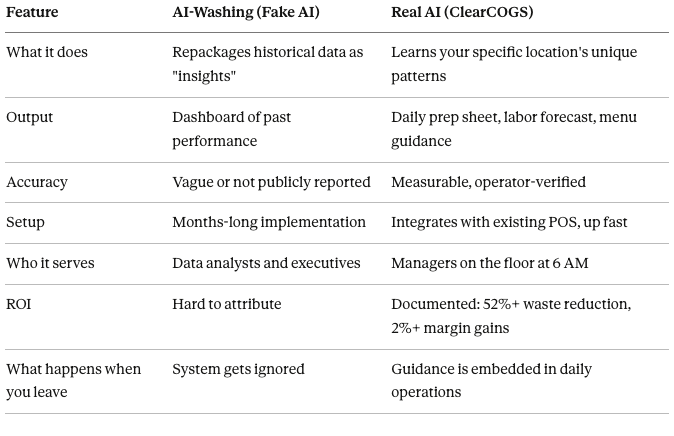
AI-Washing vs. Real AI: A Side-by-Side Comparison
Why Restaurant Operators Are Skeptical (And Why That’s Fair)
The QSR Magazine article was right about one thing: operators deserve better than what a lot of vendors are selling. The restaurant industry runs on margins that many other industries would consider unviable. When a franchise group or independent operator invests in a new platform, the stakes are high and tolerance for empty promises is zero.
That skepticism is healthy. It’s also why the AI-washing problem is so damaging — it makes operators distrust the real thing along with the fakes.
The solution isn’t to reject AI. It’s to demand proof.
Before signing with any restaurant technology vendor, run this checklist:
- They can explain their model in plain English, not buzzwords
- They offer a measurable pilot with defined success criteria
- Forecast accuracy is independently verifiable, not just self-reported
- Reference customers in your segment are available and willing to talk
- The output is usable by your managers, not just your analysts
- Implementation doesn’t require months of internal IT work
- ROI is documented in real operator case studies, not hypothetical projections
The Real Cost of Waiting
Here’s what the conversation rarely includes: doing nothing is also a decision, and it has a price.
Every week you run on manual prep sheets and gut-instinct scheduling is another week of predictable waste and unpredictable labor costs. The QSR Magazine article correctly identifies the risk of buying bad AI. But the risk of buying no AI, of continuing to let a stressed manager make hundred-dollar decisions based on vibes at 6 AM, is just as real.
A restaurant that runs on data-driven prep and labor decisions isn’t just more profitable. It’s more consistent, easier to scale, and far less dependent on the institutional knowledge of any one manager. When your veteran kitchen lead calls in sick, the AI forecast doesn’t care. The prep sheet is still right.
Read more: Restaurant Technology — Fear vs. Reality →
What the Next Three Years Look Like for AI-Forward Operators
Operators who are implementing real AI forecasting now are building a compounding advantage. The model gets smarter as it learns more about your specific locations. Decision-making improves over time. And as the industry’s margins continue to compress under rising food and labor costs, the gap between operators running on data and those running on instinct will only widen.
Operators who lean in early won’t just protect their margins. They’ll run leaner, expand faster, and deliver more consistent guest experiences, because when the numbers are handled, the team can focus on hospitality.
Key Takeaways
- AI-washing is real and widespread. Most “AI-powered” restaurant tools are rebranded legacy products.
- Real restaurant AI uses machine learning trained on your specific data to generate actionable daily decisions, not dashboards of past performance.
- ClearCOGS customers have documented 52%+ prep waste reduction, 55% waste cuts across multiple brands, and 2+ margin point improvements within the first month.
- The way to protect yourself from bad AI is to demand proof: measurable pilots, verifiable accuracy, and reference customers.
- Waiting is also a choice. The cost of continued manual decision-making is real and calculable.
- The operators building a data-driven operation today will have a structural advantage over those who wait.
Frequently Asked Questions
Is AI for restaurants actually proven, or is it still experimental? For the right use cases, prep forecasting, labor scheduling, and menu demand prediction, AI is well past the experimental stage. Documented operator results, including 52% prep waste reductions and measurable margin improvements in the first month, show that real AI delivers real ROI when it’s built on genuine machine learning rather than marketing language.
How is ClearCOGS different from other restaurant AI platforms? ClearCOGS builds a model trained specifically on your restaurant’s data, not generic industry averages. The output is designed for the manager at 6 AM, not the CFO running a quarterly review. It integrates with your existing POS (including Toast), requires no lengthy implementation, and produces results that are measurable from day one.
What if my managers don’t trust the AI recommendations? This is a real and common challenge. ClearCOGS addresses it by making forecasts transparent and trackable. When managers see that the system was right, like the Red, White & Que pitmaster who doubled his rib prep and sold out, trust builds quickly. The goal is AI-assisted decisions, not AI-replaced ones.
How long does it take to see results? Most ClearCOGS operators see measurable improvements within the first 30 days. Goop Kitchen added two margin points in month one. The 52% prep waste reduction case study was documented within a single month of implementation.
What’s the risk of not adopting AI now? The risk is compounding. Every month you run on manual processes is another month of avoidable waste, inconsistent staffing, and decisions made on gut feel rather than data. As food and labor costs continue to rise and guest tolerance for operational mistakes shrinks, the cost of inaction grows — even if it’s harder to see on a P&L than a bad AI investment.
How do I evaluate whether my current AI vendor is actually using AI? Ask them to explain their model, show you accuracy data from current customers in your segment, and demonstrate what decision your manager makes differently because of their tool. If they can’t answer those questions concisely, the technology probably isn’t what they’re selling.
Ready to see what real AI-powered forecasting looks like for your operation? Book a meeting with the ClearCOGS team →


